

- The City of Dwarka: Krishna's Ancient Capital
 dwaraka under water
Mahabharata says Dwarka is a magnificent, well-fortified city that drowned in the sea after Krishna went to heaven. It sounds mythical until archaeological excavations have recently unearthed structures off modern-day Dwarka in Gujarat, which dates between 1500 BCE and 2000 BCE. Marine archaeologists found submerged remnants of a city with walls, pillars, and a grid pattern. Potteries and artifacts similar to those described in Mahabharata.
Story Behind the Evidence:
Mahabharata reports that the great architect Vishwakarma built Dwarka as an abode of Krishna and his people. According to it, it was such a city without parallel in beauty and prosperity. Swallowed by sea after the death of Krishna-phenomenon which has already been testified to by geology through findings that sea level must have gone higher in the distant past.
- Kurukshetra: The Field of the Great War
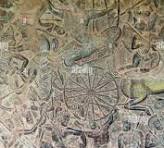 mahabharata battle
The battle of the Mahabharata was fought on the plains of Kurukshetra. The historical site that exists today in Haryana is called Kurukshetra. Archeological surveys have unearthed:
The Painted Grey Ware (PGW) dates back to 1000 BCE, aligning with the Mahabharata period.
Weapons and chariots along with human skeletons, suggest that it was a large battle.
Story Behind the Proof:
It narrates the Kurukshetra war as a battle involving millions, where rivers of blood flowed across the battlefield. The discovery of ancient battlefield relics near Kurukshetra adds weight to this story that it was not a bedtime story by our ancestors but it happened.
- Iron Pillar of Delhi: Indestructible Wonder
 iron pillar of delhi
One of the most mysterious structures related to the Mahabharata period is the Iron Pillar in Delhi. According to local legends, this pillar was erected during the reign of King Yudhishthira, the eldest Pandava. The pillar's remarkable rust-resistant properties have puzzled scientists.
Story Behind the Proof:
The Mahabharata describes Yudhishthira's rule as one of prosperity and technological advancement. While it is debated whether the Iron Pillar directly dates back to his era, its connection to advanced metallurgy aligns with the skills attributed to the people of that time.
- Hastinapur: The Capital of the Kuru Kingdom
 hastinapur
The Mahabharata identifies Hastinapur as the capital city of the Kuru dynasty. Modern excavations at Hastinapur in Uttar Pradesh have revealed:
City Ruins agrees with accounts in the Epic.
Flooding is the same account of the inundation of the Ganga River when it overflowed the city of Hastinapur which compelled the Kuru dynasty to relocate its capital.
Tale of the Proof
Mahabharata relates how King Nichakshu, a more recent scion of the Pandavas, relocated his capital to Kaushambi, following a disastrous flood, and archaeological evidence verifies this.
- Saraswati River: Life-Line of a Forgotten Civilization
 saraswathi river
There is constant reference to the great river Saraswati, running across the Kuru region, in the Mahabharata. Long since been written off as a mythical river by historians, because it no longer existed as a river. Using satellite images and a geological survey, this is what was found:
Old River Bed Running Dry in Northwest India: That Describes Saraswati River.
Settlements along the river course which are as old as the Mahabharata.
Story Behind the Evidence:
The Mahabharata talks about the Saraswati as a river that was very sacred and was used both for Vedic rituals and other everyday purposes. The rediscovery justifies the geography behind the story.
- High Level of Astronomy in Mahabharata
 astronomy in mahabharata
The Mahabharata is replete with accurate astronomical references. As an example, the epic hints that the Kurukshetra war occurred on a particular lunar day, narrating the planetary positions. Modern software simulations have traced these celestial alignments to around 3067 BCE.
Story Behind the Proof:
Sage Vyasa has written Mahabharata claiming to have mentioned the events chronologically and positions of stars and planets. One can date when these events did occur.
- The testimony of Megalithic culture
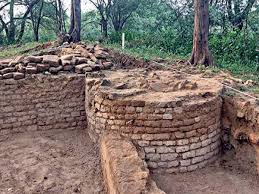 megalithic culture of hastinapur
The Life of Pandavas is further marked by an encounter with diverse tribes and sections of society. Archeological excavations that have been taken up in this regard at places across India found:
Burial practices and artifacts which coincide with the tribal practices as mentioned in Mahabharata.
Tools and weapons as found in the epic.
Story Behind the Evidence:
The best-known story from Mahabharata's life in exile is that of Bhima's encounter with Rakshasa Hidimba whom he defeats, then marrying the latter's sister, the tribal princess, Hidimbi who lived in the forest. Cultural details narrated in such stories do throw up the megalithic practice and hence there are proofs by archaeological excavations.
Conclusion:
Captivated human imagination through the blend of mythology, philosophy, and history since centuries ago, the Mahabharata appears to hold enough archeological evidence alongside detailed accounts of geography, astronomy, and cultures. Whether or not it be a fact or fantasy, the epic will remain to this day one source of wisdom and inspiration through this timeless bridge from the past into the future.
By piecing together stories from the epic and findings from the archeological world, we come up with a narrative that is as interesting as it is profound. As scientists and historians dig deeper, the line between myth and history becomes increasingly blurred, keeping the legacy of the Mahabharata alive for generations to come.